Solutions and Technologies for Utility Success
Utilities are evaluating 24‑month operating cycles to improve plant economics, increase capacity factors and optimize outage schedules. Westinghouse supports this transition through its High Energy Fuel (HEF) Program, integrating advanced fuel technologies, engineering services and licensing‑ready methodologies to enable higher enrichment, higher burnup and improved fuel performance while maintaining safety and reliability.
Customer Benefits
- Ability to skip one refueling outage every 6 years
- Increased generation and higher capacity factors
- Optimized outage scheduling for fleet operators
- Long-term reduction in fuel and operating costs
- Alignment with uprates and long-term strategies
- Clear, licensing ready path to extended cycles
U.S. Policies & Electrical Demand
U.S. energy policy and rising electricity demand are driving increased focus on maximizing output from the existing nuclear fleet through uprates, long‑term operation, and extended fuel cycles.
Key Policy & Market Drives
- Infrastructure Investment and Jobs Act (2021): Supports continued operation of the fleet as part of national clean‑energy and reliability objectives
- Inflation Reduction Act (2022): Provides financial incentives for clean energy generation, explicitly including nuclear power uprates
- Rising Electricity Demand: Increases focus on maximizing generation from existing plants
- Extended Fuel Cycles: Enable additional clean generation by reducing refueling outages
Integrated Fuel & Engineering Services Solution
Westinghouse delivers an integrated solution that combines advanced nuclear fuel technologies with Engineering Services to support 24‑month fuel cycle implementation while reducing risk and simplifying execution.
Integrated Solution Capabilities
Advanced Fuel & Analytical Foundation
- EnCore PWR High‑Energy Fuel products designed for higher duty operation
- Licensing‑ready analytical methods and fuel management expertise
First‑Time Engineering for Cycle Extension
- Instrumentation and uncertainty evaluations
- Procedure updates and engineering program reviews
Engineering & Licensing Support
- Fuel management and transition scoping studies
- Reload, safety and licensing analyses
- Early and sustained regulatory engagement
Design & Training Solutions
- Coordinated design package development
- Preliminary Training Needs Analysis
- Support for training content and program updates
Typical Transition Path
Utilities typically follow a phased, engineered approach to reach 24‑month operation, building margin and capability over time rather than making a single step change.
Typical Transition Phases
- Baseline 18‑Month Cycle: Existing fuel designs and standard burnup limits
- Optimization Phase: Advanced fuel features and incremental burnup extensions
- Transition Phase: First‑time engineering, reload and safety analyses, regulatory engagement
- 24‑Month Operation: Licensed extended cycles with higher enrichment and burnup pathways
Key Technologies
- ADOPT™ Fuel Pellets: Higher uranium density supports improved fuel utilization
- PRIME™ Fuel Features: Advanced skeleton and debris-resistant design enhances robustness under higher duty conditions
- AXIOM® Cladding: Next-generation cladding provides improved corrosion resistance and mechanical performance at higher burnups
- Higher Enrichment (LEU+) & Burnup: Pathways above 5.0 w/o U-235 and burnups approaching ~75 GWd/MTU enable economic 24-month cycles
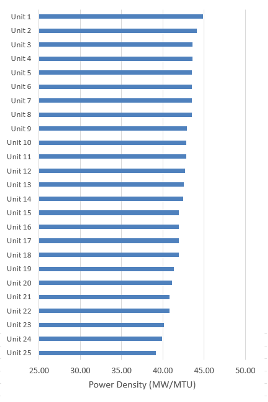
Example Power Densities
Applicability Across PWR Fleets
24‑Month Fuel Cycle Solutions are applicable across a wide range of pressurized water reactor (PWR) designs, including operating plants and future new builds. Economic benefits are optimized for those units above a certain Power Density.
Flexible Deployment
- Scalable for single‑unit or fleet implementation
- Applicable to existing PWRs and AP1000® plants
- Aligns with long‑term operation strategies
AP1000® Plants
AP1000® plants are uniquely positioned to pursue 24‑month fuel cycles as part of their long‑term operating strategy. Utilities are evaluating phased transitions that build on initial 18‑month operation.
Key AP1000 Considerations
- Initial operation typically begins with 18 month fuel cycles
- Transition to 24 month cycles planned later in plant life
- Higher enrichment pathways (LEU+) may be required for economic operation
- Early fuel management studies support future licensing and deployment
- Higher Enrichment (LEU+) and Burnup: Pathways 2026 Westinghouse